

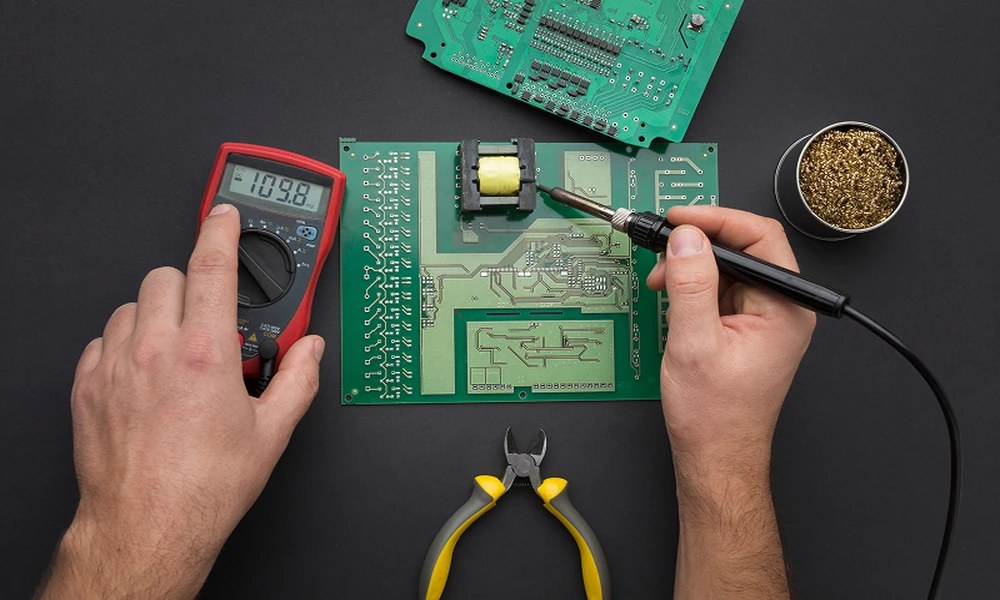
A printed circuit board (PCB) prototype is the last real opportunity to catch problems before they are repeated across hundreds or thousands of units. A design that works on a single board on the bench may still fail under heat, vibration or slight variations in assembly. Working with prototype PCB assembly services allows engineers to evaluate a small batch of boards built under realistic conditions, but the value of that batch depends on how thoroughly it is tested. A structured test plan helps teams approve production with fewer surprises.
Visual and Physical Inspection
Before any power is applied, a close inspection can reveal assembly and fabrication issues that might otherwise damage the board. Engineers typically begin by checking the following:
- Solder joints for bridging, insufficient solder or cold joints, particularly on fine-pitch components.
- Component placement and orientation, including polarised parts such as diodes and electrolytic capacitors.
- Board dimensions, mounting holes and connector positions against the enclosure design.
- Warping, delamination or damage to the board surface.
Power and Electrical Checks
Powering a board for the first time carries some risk, so electrical checks are usually carried out step by step. A careful power-up process often includes these stages:
- Measuring resistance between power rails and ground to detect shorts before applying power.
- Using a current-limited supply to bring the board up gradually.
- Verifying that each voltage rail sits within its specified tolerance.
- Monitoring regulators and power components for unexpected heat.
Functional Testing
Once power is stable, each part of the circuit needs to be confirmed as working as intended. Functional testing usually covers areas such as these:
- Programming the microcontroller or processor and confirming the firmware runs correctly.
- Testing communication interfaces, such as USB, UART, SPI, I2C or Ethernet.
- Checking inputs and outputs, including buttons, sensors, displays and indicators.
- Verifying timing-sensitive signals with an oscilloscope or logic analyser.
- Confirming that the board behaves correctly during power cycling and resets.
Manufacturability and Assembly Review
A board that functions correctly may still be difficult or costly to produce in volume. Once the time comes to order custom PCB batches at scale, small design issues are multiplied across every unit, so it helps to review these points with the manufacturer:
- Feedback from the assembler on footprints, pad sizes or spacing that caused difficulties.
- Whether fiducial marks, tooling holes and panelisation suit automated assembly lines.
- Accessible test points that allow in-circuit or functional testing during production.
- The availability and lifecycle status of every component on the bill of materials.
- Approved alternative parts in case a component becomes scarce.
Environmental and Stress Testing
Real-world operating conditions are often harsher than the lab environment. Depending on where the product will be used, engineers may subject prototypes to tests such as these:
- Temperature cycling to check performance at the upper and lower limits of the specification.
- Humidity exposure, particularly for products intended for tropical or outdoor use.
- Vibration and drop testing for portable or vehicle-mounted devices.
- Pre-compliance electromagnetic compatibility (EMC) testing to identify emissions issues early.
- Extended burn-in runs to reveal components that fail after hours of continuous operation.
Consistency Across Multiple Prototype Units
A single working board does not prove that the design will perform reliably in volume. Testing several units from the prototype batch helps confirm that results can be repeated, especially when engineers check the following:
- Whether key measurements, such as voltages and current draw, stay consistent from board to board.
- Whether any failures appear on some units but not others, pointing to assembly or tolerance issues.
- Whether boards that received design changes were retested to confirm the fix.
- Whether the planned production test procedure runs smoothly on every prototype.
Signing Off With Confidence
Approving a PCB for mass production is a significant commitment, and the prototype stage is the most cost-effective time to resolve problems. Thorough inspection, careful power-up, functional checks, manufacturability review and stress testing together give teams a clear basis for moving forward.
Ready to take your design from prototype to production? Connect with MPN Tech for a prototype assembly quote.